Resuscitation: Key Skills That Save Lives
Sudden cardiac arrest can happen anywhere – at home, in the street, in the office or on the production floor. Until the ambulance arrives, the victim’s life depends on the bystander. Every minute without defibrillation reduces the chance of survival by about 10%, which is why resuscitation is one of the most important skills anyone can learn.
What is resuscitation?
Resuscitation is a set of actions aimed at restoring or maintaining blood circulation and breathing in a person in sudden cardiac arrest (SCA). When the heart stops pumping blood effectively, the brain begins to suffer irreversible damage within just a few minutes.
Basic life support (BLS) can and should be performed by every bystander. It requires no medical equipment – all you need are your hands, a phone and, if one is nearby, an automated external defibrillator (AED). Advanced life support (ALS) is provided by emergency medical teams.
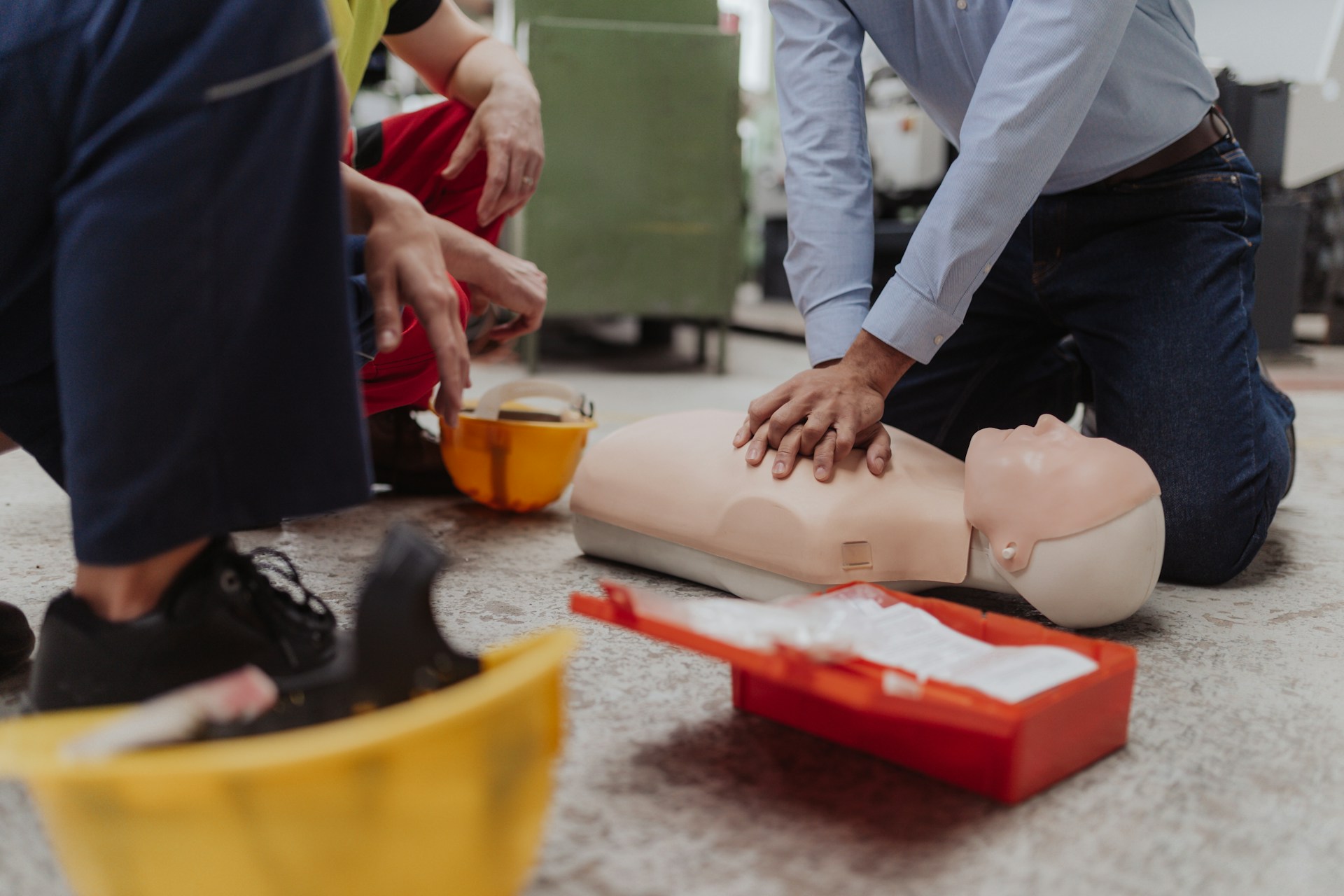
During first aid training, employees often stress that they did not know how to react, for example, to an unconscious person or massive bleeding. For many people, the training run by EHS Consulting is the first opportunity to practise giving first aid hands-on. We use manikins, training defibrillators and vests for practising how to deal with choking. Participants sometimes share memories of previous training sessions that were based solely on theory – and as a result, employees left them without knowing how to react in practice in an emergency.
Dawid Kaczmarski, serving firefighter and qualified first aid rescuer (KPP)
Why is resuscitation important?
According to data cited in the European Resuscitation Council (ERC) Guidelines 2025, emergency medical services in Europe attempt to treat out-of-hospital cardiac arrest in about 55 people per 100,000 inhabitants per year. On average, only 7.5% of victims survive, and depending on the country this rate ranges from 3.1% to 35%.
Such a wide range is largely due to the behaviour of bystanders:
- on average, 58% of bystanders start CPR before the ambulance arrives, but in some regions only 13% do,
- an AED is used before the emergency team arrives in between 2.6% and 59% of cases,
- up to 70% of cardiac arrests happen at home, where help can only come from someone close to the victim.
Chest compressions maintain blood flow to the brain and heart, and early defibrillation can restore a normal rhythm. It is the bystander who “buys time” until the professionals arrive.
A true story: Lubawa, a family sports day in a school gym
During a tug-of-war at a school family sports day, a 38-year-old father of three suddenly collapsed – he stopped breathing and went into cardiac arrest. The ambulance was out of town. Grzegorz Kowalkowski, a retired police officer, together with a nurse and a police officer, started resuscitation and kept it going without a break. Another bystander drove to fetch the AED mounted at a nearby nursery school. The first shock did not help; after the second, the heart started working again. The man was taken to hospital conscious and responsive. The rescuer later stressed that his confidence came from previous AED training. (source: infoilawa.pl – in Polish)
Types of resuscitation: CPR and AED
In first aid, two elements are key, and they work best together.
| CPR (cardiopulmonary resuscitation) | AED (automated external defibrillator) | |
|---|---|---|
| What it involves | Chest compressions and rescue breaths in a 30:2 ratio | Analysis of the heart rhythm and – if needed – an electric shock |
| What it does | Maintains blood flow to the brain and heart | Can restore a normal heart rhythm |
| Who can do it | Any bystander, even without training (compressions only) | Anyone – the device gives voice prompts |
| What you need | Your hands – ideally on a firm surface, but without moving the victim, e.g. from a bed to the floor | An AED with electrode pads |
CPR alone rarely restarts the heart, but it keeps the organs alive until defibrillation. An AED, in turn, loses its effectiveness without compressions before and after it is used. That is why the ERC Guidelines 2025 combine both elements into a single sequence of actions.
Key resuscitation skills
Effective help is not just about compression technique. A bystander rescuer should be able to:
- assess the safety of the scene before approaching the victim,
- call for help effectively – if the victim does not respond, call 112 or 999 (the Polish emergency numbers) straight away, switch on the speakerphone and follow the dispatcher’s instructions,
- recognise cardiac arrest – no response and no normal breathing (agonal breathing, i.e. infrequent, irregular gasps, is not normal breathing); the dispatcher will help you assess breathing,
- deliver high-quality compressions – in the right place, at the right rate and depth,
- use an AED and know where the nearest defibrillator is,
- work with others – swap over on compressions about every 2 minutes to maintain their quality,
- stay calm and keep going until the emergency medical team arrives.
How to perform CPR correctly
The ERC Guidelines 2025 describe the ASSESS – CALL – CPR sequence. An important change compared with earlier guidelines: if the victim does not respond, call for help first, and assess breathing while you are already in contact with the dispatcher.

- Safety – make sure that you, the victim and any bystanders are not in danger.
- Check for a response – gently shake the victim by the shoulders and ask loudly: “Are you all right?”.
- Call for help – if the victim does not respond, immediately call 112 or 999 (or ask someone to do it) and switch on the speakerphone. Send someone to fetch an AED.
- Open the airway – tilt the head back and lift the chin.
- Assess breathing – look, listen and feel for no more than 10 seconds; the dispatcher will help you judge whether breathing is normal. If breathing is not normal, you must start CPR.
- Start chest compressions:
- one hand on top of the other in the centre of the chest (lower half of the breastbone),
- arms straight, shoulders vertically above the chest,
- depth 5–6 cm, rate 100–120 compressions per minute,
- after each compression, let the chest recoil fully without lifting your hands.
- Rescue breaths – if you are trained, give 2 breaths after 30 compressions (each lasting about 1 second, until the chest rises). If you cannot or do not want to give them, perform compressions only.
- Continue until the emergency team arrives, an AED is connected or normal breathing returns.
Important: brief seizure-like movements are common at the onset of cardiac arrest. When they stop, assess breathing immediately – do not mistake SCA for an epileptic seizure.
Using an AED: step by step
An AED is designed so that anyone can use it. The device analyses the heart rhythm by itself and will not deliver a shock if one is not needed.
- Switch on the AED and follow the voice prompts.
- Expose the victim’s chest. If necessary, wipe it dry.
- Attach the pads as shown in the diagram: one below the right collarbone next to the breastbone, the other on the left side of the chest, below the armpit.
- Do not stop compressions until the AED starts its analysis – if a second person is helping, they should attach the pads while you do compressions.
- Stand clear during the analysis – nobody may touch the victim.
- Deliver the shock if the AED asks you to, making sure nobody is touching the victim.
- Resume compressions immediately – both after a shock and when the AED advises against one. The device will repeat the analysis about every 2 minutes.
You can find the nearest AED in apps with a map of defibrillators or ask the emergency number dispatcher (112 or 999). The ERC recommends that public AEDs be clearly signposted, registered and accessible 24/7.
A true story: Białołęka, Warsaw
In November 2024, municipal police officers received a report of a “sleeping” man. At the scene, it turned out that the pensioner was unresponsive, not breathing and had no pulse. The officers immediately started CPR and called an ambulance, while an employee of a nearby institute brought an AED. The trained officers attached the pads and followed the device’s instructions. After a few minutes, the man began breathing on his own and was handed over to the emergency medical teams. This story shows well that the outcome depends on the whole chain: a quick reaction, compressions and an AED within reach. (source: se.pl – in Polish)
The most common mistakes during resuscitation
| Mistake | Why it is harmful | What to do instead |
|---|---|---|
| Delay in taking action | Every minute without help reduces the chance of survival | Start straight away, even without training |
| Checking for a pulse or assessing breathing for too long | Delays compressions | Assess breathing for no more than 10 seconds |
| Mistaking agonal breathing for normal breathing | The victim does not get help | Infrequent gasps = cardiac arrest |
| Compressions too shallow or too slow | Blood does not reach the brain | 5–6 cm, 100–120/min |
| Not letting the chest recoil fully after each compression | The heart does not fill with blood | Full recoil, hands on the chest |
| Moving the victim from a bed to the floor | Delays the start of CPR | Compress on the bed, pressing deeper if necessary |
| Long pauses (e.g. when attaching the AED) | Blood flow drops | Pause only for analysis and the shock |
| Breaths that are too forceful or too long | Air enters the stomach | About 1 s, until the chest rises |
| Not swapping rescuers | Fatigue reduces the quality of compressions | Swap about every 2 minutes |
| Fear of using the AED | Delayed defibrillation | The AED itself decides whether a shock is needed |
Resuscitation training and courses
Resuscitation cannot be learned from an article or a video alone. The correct depth and rate of compressions are developed on a manikin under the eye of an instructor, and the skills need to be refreshed regularly.
In the workplace, first aid training is also a legal obligation. Under Article 209¹ of the Polish Labour Code, the employer must provide the means necessary for giving first aid and designate employees to give it. The number of these people, their training and equipment should correspond to the type and size of the business and the hazards present in the workplace.
Good resuscitation training should include:
- hands-on practice on manikins (adults, children, infants),
- use of a training AED,
- scenarios tailored to the workplace (e.g. production hall, office, field work),
- the current ERC Guidelines 2025,
- sessions run by practitioners – paramedics.
How to prepare for emergencies
In an emergency, what counts is what was prepared beforehand. In a company, it is worth making sure of:
- designating and training first aiders on every shift,
- first aid kits or first aid points with up-to-date equipment and a person responsible for their condition,
- an AED in a visible, signposted and accessible place, with the battery and pads checked regularly,
- a posted first aid instruction and a list of emergency numbers,
- a clear procedure: who calls 112 or 999, who brings the AED, who goes out to meet the ambulance,
- periodic scenario-based drills, for example combined with evacuation drills.
A true story: a power line crew working in the field (USA, 2026)
In May 2026, a crew of power line workers was replacing a pole when the supervising inspector collapsed next to the work site – he had gone into cardiac arrest. Two linemen immediately started compressions and rescue breaths, while the foreman brought the AED from the crew’s equipment and operated it together with another worker. The others stayed in contact with the dispatcher and guided the ambulance through a gated housing estate. The inspector survived. The team had only been working together for two weeks – what made the difference was not familiarity, but a clear division of roles and an AED at the workplace. (source: IBEW 1245)
In your private life, it is worth knowing where the nearest AED is near your home and workplace and installing an app with a map of defibrillators.
Remember too that giving help is an obligation. The Polish Act on the State Emergency Medical Service requires anyone who sees a person in a state of sudden health risk to notify the emergency services immediately, and a person giving first aid enjoys the legal protection provided for public officials.
Summary
Resuscitation is a simple sequence of actions: check for a response, call 112 or 999, assess breathing, compress the chest and use an AED. The biggest mistake is doing nothing – even imperfect CPR gives the victim a better chance than no help at all. However, only practice gives you confidence in this situation.
Expert view
I am deeply convinced that first aid knowledge is something we all truly need. In a life-threatening situation, the bystander is one of the most important links in the chain of survival.
The medical dispatcher is invaluable support, which is why, as a professional paramedic, I recommend calling 999 in a life-threatening situation and following the dispatcher’s guidance.
Let us remember that a quick reaction by the bystander, immediate cardiopulmonary resuscitation and early use of an automated external defibrillator (AED) significantly increase the chances of survival. Every minute counts, especially for the brain, which is damaged very quickly without an adequate supply of oxygen.
I am a great advocate of frequent, short and, above all, practical first aid training. It is better to practise regularly for 2–3 hours than to attend a training session lasting many hours once every few years and hope that we will remember everything when it matters. Because first aid is not just knowledge. It is a skill, courage and readiness to act when someone next to us needs help.
Karol Bączkowski, paramedic
Sources
- Polish Resuscitation Council – “ERC Guidelines 2025” brochure – in Polish
- Polish Resuscitation Council – Resuscitation Guidelines 2025 – in Polish
- Polish Labour Code, Article 209¹
- Act of 8 September 2006 on the State Emergency Medical Service, Articles 4 and 5