
OSH Outsourcing in Poland – The Answer to a Missing OSH Specialist
Labour shortages are something companies feel more and more on a daily basis. When the vacancy is for an OSH specialist, the problem goes beyond an overstretched team – the employer risks gaps in duties for which they are personally responsible. Outsourcing OSH services provides professional support straight away, without months of recruitment.
According to the Gi Group report “Labour Market and Salaries in Manufacturing and Logistics 2026”, covered by Strefa Biznesu, 62.6% of manufacturing and logistics companies had their operations disrupted by staff shortages at least six times in a year. As many as 54% of companies rate the limited availability of candidates as a high or very high risk to business continuity, and 52% say the same of skills shortages.
Teams are feeling the effects: 96% of companies report a heavier workload for employees, 91% an increase in overtime and 85% additional duties for foremen and shift managers. From an OSH perspective, this is a warning sign – fatigue, haste and taking over other people’s tasks are classic causes of accidents at work.
From what I observe during audits at our clients’ sites, when staff are short, employers often forget to delegate tasks properly. An employee covering for a colleague who is, for example, on sick leave quite often does work they should not normally be doing, because they lack the relevant qualifications or competence. And in such a situation it sometimes takes very little for an accident to happen.
Why is it so hard to find a good OSH specialist?
Today, the role of an OSH specialist demands much more than delivering training and keeping records. Employers are looking for people who combine knowledge of the regulations with hands-on experience in a specific industry. There are few such candidates on the market.
The most common obstacles in recruitment:
- Narrow specialisation – a plant with chemical agents, machinery or an ATEX zone needs someone who knows these issues in practice, not just from a course.
- Formal requirements – the regulations set out the qualifications and length of experience required for individual positions in the OSH service, which narrows the pool of candidates even further.
- Broad scope of duties – OSH is increasingly combined with fire safety, environmental protection, ADR or ISO standard requirements. One person rarely covers all of these areas.
- Turnover and absence – if your only specialist leaves or goes on long-term sick leave, OSH duties are left without anyone in charge overnight.
- Time – recruitment, the notice period and onboarding a new person often take several months, and in the meantime deadlines for training, risk assessments and inspections do not wait.
Outsourcing OSH services can be the answer to what the market needs. A company that professionally supports businesses gives us access to consultants from a range of fields – from occupational safety to fire safety and machinery safety – so we get answers to our questions faster and more comprehensively than from a single in-house OSH employee
What is OSH outsourcing?
OSH outsourcing means entrusting the tasks of the OSH service to an external company that acts on the employer’s behalf under a contract. It can replace an in-house specialist entirely or complement the work of an internal department in areas where it lacks time or expertise.
A typical scope of ongoing OSH support includes:
- periodic inspections of working conditions and compliance with regulations,
- initial and periodic training (also as e-learning),
- occupational risk assessment and job-specific instructions,
- establishing the circumstances and causes of accidents at work,
- advice on purchasing machinery, organising workstations and selecting personal protective equipment,
- handling inspections by the National Labour Inspectorate (PIP) and the State Fire Service (PSP), and preparing for audits,
- keeping you informed about changes in the law on an ongoing basis.
The scope can be extended to fire safety, first aid, machinery safety and LOTO, chemical substances, ATEX, ADR or environmental protection – so that a single partner is responsible for all EHS matters.
The scope of cooperation, the frequency of visits, contact with the dedicated consultant and the response in urgent situations are always agreed individually when the cooperation begins. This contractual flexibility makes working with an external company more attractive than signing an employment contract with a single specialist.
In-house or outsourced? A comparison
The biggest advantage of outsourcing is that the employer buys the ready-made expertise of a whole team, not of a single person.
| Criterion | In-house specialist | OSH outsourcing |
|---|---|---|
| Time to get started | Several months (recruitment, notice period, onboarding) | A few days to a few weeks |
| Range of expertise | One person’s knowledge | A team of specialists from different areas (OSH, fire safety, chemicals, machinery, ATEX) |
| Holidays, sickness, resignation | Gap in coverage | Continuity – cover is provided by the external company |
| Costs | Salary, social security contributions, training, equipment, recruitment | A fixed, predictable fee matched to the scope |
| Up-to-date knowledge | Depends on individual development | Experience shared across many industries and ongoing monitoring of regulations |
| View of the site | From the inside, with a risk of “getting used to things” | An independent, fresh auditor’s perspective |
| Day-to-day knowledge of the company | Full, on-site presence | Requires good communication and a dedicated consultant |
Outsourcing does not have to mean doing without your own employee. A mixed model is increasingly popular: an in-house specialist handles day-to-day matters, while the external company provides expert support, cover and specialist tasks.
At EHS Consulting, we see the mixed model more and more often, particularly at companies with over 600 employees. The business decides to employ someone in-house, but also needs support from an external company – for example when that employee is absent from work, or for issues that require highly specialised knowledge
What does the law say about an external OSH service?
The Polish Labour Code expressly allows OSH support to be outsourced. Under Article 23711 § 2 of the Labour Code, an employer that does not have competent employees may entrust the tasks of the OSH service to specialists from outside the workplace.
Basic rules for organising the OSH service (Article 23711 § 1 of the Labour Code):
- more than 100 employees – the employer sets up an OSH service,
- up to 100 employees – the tasks of the OSH service may be entrusted to an employee who is employed to do other work,
- up to 10 employees (or up to 50 if the company belongs to a group of activities with a risk category no higher than three) – the employer may perform these tasks personally after completing the appropriate training.
An external specialist must meet the same qualification requirements as an employee of the OSH service and must have completed the training for employees of that service. The detailed qualifications and scope of activities are set out in the Council of Ministers Regulation on the occupational safety and health service.
Bear in mind that entrusting these tasks to an external company does not transfer the employer’s responsibility for the state of OSH in the workplace to that company (Article 207 of the Labour Code). This is why choosing a reliable partner matters so much. A labour inspector may also order the employer to set up an OSH service or increase its headcount if this is justified by occupational hazards (Article 23711 § 4 of the Labour Code).
For companies with more than 100 employees, it is worth thinking carefully about how to organise the OSH service. If we have office staff who work remotely and occupational exposure is low, an external company can perform the specialist’s tasks without any difficulty. If, however, we run a manufacturing or construction business, it is worth asking whether we need OSH support every day. If we do, hiring a full-time employee or choosing a hybrid option (a full-time employee plus an external company) may be the better solution
How to choose an OSH services provider
A good external partner is about more than the monthly price. Before signing a contract, check the following:
- Team qualifications – whether the specialists meet the requirements for the OSH service and have experience in your industry.
- Range of expertise – whether the company can also handle fire safety, first aid, chemicals, machinery or ADR if you need them.
- A dedicated consultant – whether you have an assigned person who knows your site, with cover guaranteed.
- A clear contract scope – the number of visits, completion deadlines and response time in urgent situations (e.g. an accident at work).
- References – feedback from clients with a similar business profile.
- Up-to-date knowledge – whether the company informs you about changes in the law and helps you implement them.
- Tools – e.g. an e-learning platform for periodic training or an electronic register of deadlines.
A very low price can be a red flag when choosing a service provider. Bear in mind that when calculating their rates, companies such as EHS Consulting take into account personal data protection, the cybersecurity of their platform, cover for the person assigned to your account and many other factors – which means that a monthly OSH subscription will cost more than with a freelancer who only started doing OSH “yesterday”
Summary
Staff shortages are a real operational problem today, and an unfilled OSH specialist position also brings legal and safety risks. Outsourcing provides professional support straight away, without months of recruitment, with access to a team of specialists and guaranteed continuity.
EHS Consulting provides ongoing OSH and fire safety support, support for in-house OSH services and advice on chemicals, ATEX, LOTO, machinery safety, ADR and environmental protection. Our team consists of 15 specialists, and we keep our clients regularly informed about changes in the law through our weekly newsletter (in Polish).
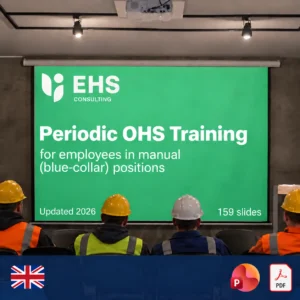
Even without an OSH specialist on board, periodic OSH training still has to be completed on time. Run it for your English-speaking staff with a ready-to-use presentation designed for manual-worker positions – entirely in English.
-
 Product on saleSzkolenie okresowe BHP dla stanowisk robotniczych – gotowa prezentacja po angielskuOriginal price was: 70,00 zł.60,00 złCurrent price is: 60,00 zł.
Najniższa cena z ostatnich 30 dni: 60,00 zł.
Sources
- Strefa Biznesu: “More and more companies are falling into the same trap. The problem is staff” (23 October 2026) (in Polish) – based on the Gi Group report “Labour Market and Salaries in Manufacturing and Logistics 2026”
- Polish Labour Code, Article 23711 – Occupational safety and health service (in Polish)


