
Emergency & Evacuation Lighting Inspection in Poland
Polish fire safety law requires your facility to maintain working emergency lighting — and the State Fire Service (PSP) enforces it. We inspect, service, and document everything, so your Polish operation stays compliant.
Who is this service for?
International companies with a Polish subsidiary
— managing fire safety compliance from abroad is complex. We handle the technical inspections and documentation locally, so your HQ doesn’t have to.
Facility managers of Polish sites
— responsible for keeping the building compliant with Polish fire regulations (PSP requirements) and avoiding enforcement notices or operational shutdowns.
Companies setting up operations in Poland
— new to Polish regulations? We guide you through the local requirements and make sure your premises are compliant from day one.
What problems does a regular inspection prevent?
PSP enforcement notices & operational shutdowns
Polish State Fire Service inspectors routinely check emergency lighting. A failed inspection can result in a remediation order, a fine, or — in serious cases — a closure order. Our inspection report proves compliance.
Darkness during an emergency evacuation
A dead battery or a failed luminaire in a key corridor is all it takes. Emergency lighting must activate the moment mains power fails — and you need documented proof that it will.
Corporate liability exposure
Under Polish law, the owner or manager of a building is personally liable for injuries caused by a non-functional safety installation. Documented inspections are your legal shield.
Why international clients choose EHS Consulting for their Polish sites
We operate across Poland, work in English, and deliver inspection reports formatted to meet PSP expectations — so you always know exactly where your facility stands.
We know Polish fire safety law
Our specialists work to PN-EN 50172 and PN-EN 1838, and understand exactly what PSP inspectors look for. No translation required — we bridge the gap between Polish regulations and your compliance framework.
Audit-ready documentation in English
Every inspection produces a detailed report with measurement results, findings, and recommendations — delivered in a format your HQ compliance team can actually read and file.
One point of contact, nationwide coverage
Whether you have one office in Warsaw or multiple sites across Poland, we coordinate all inspections, follow up on remediation, and keep your compliance calendar on track.
How it works
01. Free initial consultation
A short call or email exchange to understand the size of your facility, the type of installation, and your location in Poland. We prepare a tailored quote from there.
02. On-site inspection & measurements
Illuminance measurements, battery autonomy tests, luminaire condition checks, and verification of evacuation sign placement — all against PN-EN 50172 and PN-EN 1838 requirements.
03. Inspection report & findings
A detailed written report listing measurement results, non-conformities, and remediation recommendations — ready to submit to PSP or include in your corporate EHS records.
04. Servicing & remediation
On request — battery replacement, luminaire repair or replacement, evacuation signage updates. We fix findings on the same visit wherever possible, so you don’t need a second contractor.
What the inspection covers
Illuminance measurement
On-site measurement of emergency and evacuation lighting levels — verified against PN-EN 1838 minimums (≥1 lx on escape route axis, ≥0.5 lx in open areas).
Battery autonomy & condition
Verification of rated backup duration (1 or 3 hours depending on building type) and physical condition of all batteries — units failing the test are flagged for immediate replacement.
Luminaire placement & signage
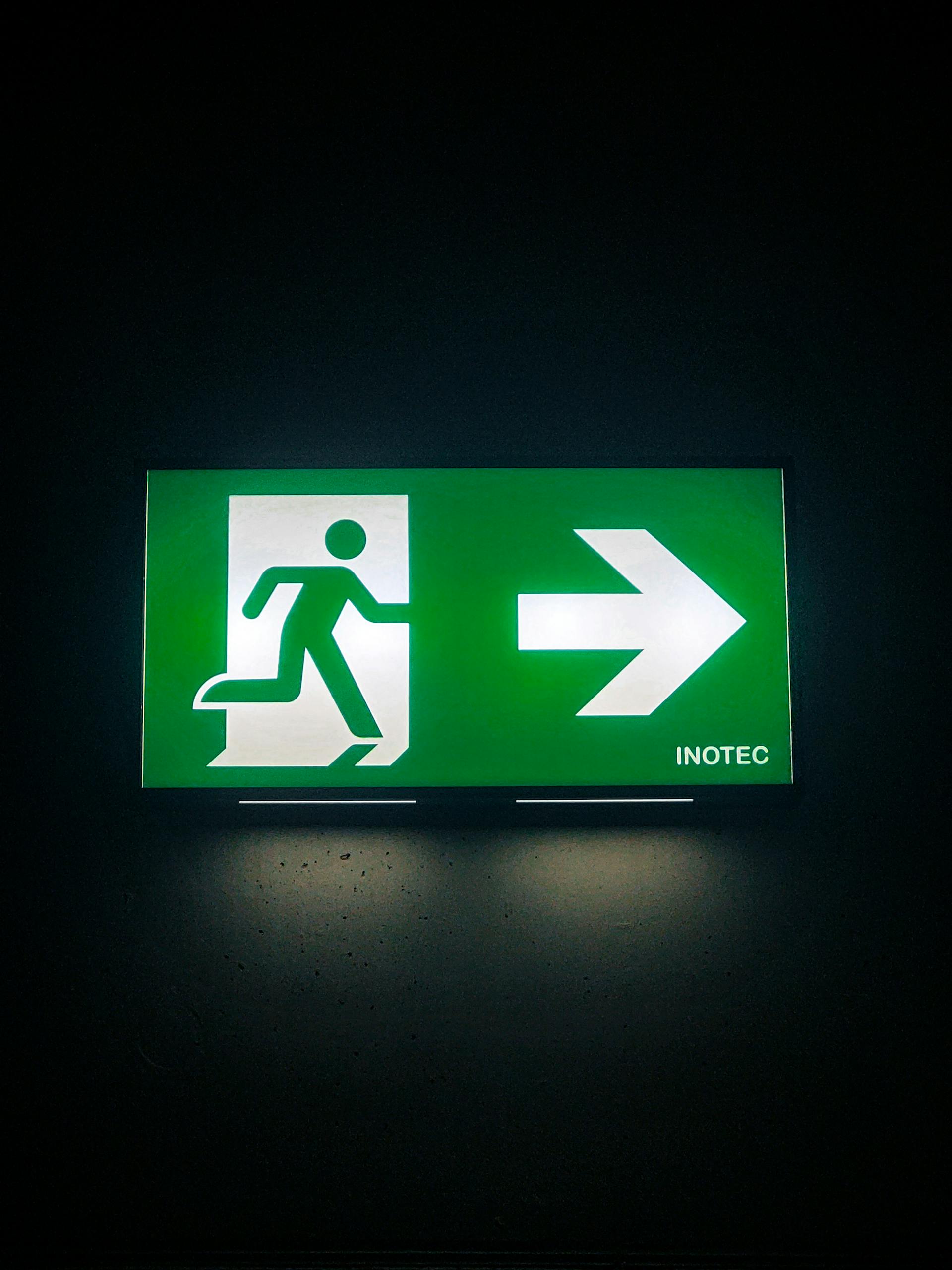
Assessment of luminaire positioning and evacuation sign coverage — we check that every escape route and room is correctly marked and lit, with no blind spots.

Compliance with PN-EN 50172 & PN-EN 1838
Full system review against both technical standards, cross-referenced with Polish building regulations (§181 of the Technical Conditions for Buildings decree).
Written inspection report
Comprehensive written report with all measurement data, identified faults, recommended corrective actions, and the next inspection due date — filed in your EHS records.
On-site servicing
Battery replacement, luminaire repair or replacement, evacuation sign updates — carried out on the same visit where possible, so your facility is back in compliance the same day.
Compliant Polish facility. Happy HQ. No surprises from PSP.
Don’t wait for a PSP inspection to discover a problem. Get ahead of it — we’ll have your emergency lighting inspected, documented, and serviced.

