
Experience and expertise
Fire safety audit and fire safety assessment of the building
Are you interested in a fire safety audit?
or call: +48 887 043 666
In accordance with the Labour Code Act, the employer is obliged to provide the necessary means for first aid in emergencies, as well as firefighting and evacuation of employees.
The purpose of the audit is to verify compliance with fire safety requirements for a given facility. As part of the fire safety assessment, the following are checked:
- fire safety organisation
- evacuation conditions,
- portable fire-fighting equipment,
- the technical condition of electrical, lightning protection and gas installations,
- storage and warehousing of materials, including those that are hazardous in terms of fire,
- fire escape routes and access roads to buildings,
- work that is hazardous in terms of fire.
FAQ
Do you have any other questions?
Check out our questions and answers – together we will dispel any doubts!
1.
Contact
The first step is to contact us by phone or email.
2.
Conversation
The second step is to understand the customer’s needs and propose terms and conditions.
3.
Collaboration
The third step is to establish cooperation and commence activities.
Why is it worth it?
references
See what our customers say about us
Definitely the most reliable and professional service in the field of health and safety and fire protection. Extensive knowledge and a team of experienced inspectors, training and service of the highest standard.
Żaneta
Krzton
The training was conducted efficiently, professionally and in a friendly atmosphere. Communication with Ms Agnieszka, answers to questions and responses to requests during the training were of a high standard, without unnecessary information.
Konrad
Wisowski
I recommend EHS Consulting in the field of health and safety. Ms Agnieszka is a competent, professional person with extensive expertise.
Working with Ms Agnieszka is a pure pleasure.
Bogusław
Tański


WHO IS RESPONSIBLE FOR THE FIRE SAFETY AUDIT?
The owner of the building or premises, its manager or user is responsible for the fire safety audit, depending on the terms of the agreement. (Act of 24 August 1991 on Fire Protection).
WHAT DOES A FIRE SAFETY AUDIT COVER?
The fire safety audit takes into account:
- fire safety organisation
- evacuation conditions
- portable fire-fighting equipment
- technical condition of electrical, lightning protection and gas installations
- storage of materials, including those posing a fire hazard
- fire escape routes and access roads to buildings
- fire-hazardous work.
WHAT DOES A FIRE SAFETY AUDIT PROVIDE?
The purpose of a fire safety audit is to verify the fire safety requirements for a given facility. It includes an analysis of the fire safety status of the building (fire safety equipment and installations, evacuation conditions, and the possibility of conducting rescue and firefighting operations).
A fire safety audit allows for the identification and elimination of any non-compliance that could result in consequences imposed by the control authorities.
- Fire safety instructions
Fire safety instructions are a document developed on the basis of
materials provided by the client, an on-site inspection of the facility and current fire safety regulations.
Its purpose is to:
- establish fire protection rules in the workplace
- familiarise employees with the fire hazard
- define the rules, tasks and responsibilities in the field of fire protection, as well as the procedures to be followed in the event of a fire or other local hazard.
WHAT DOES THE MANUAL CONTAIN?
The manual consists of:
- a descriptive part
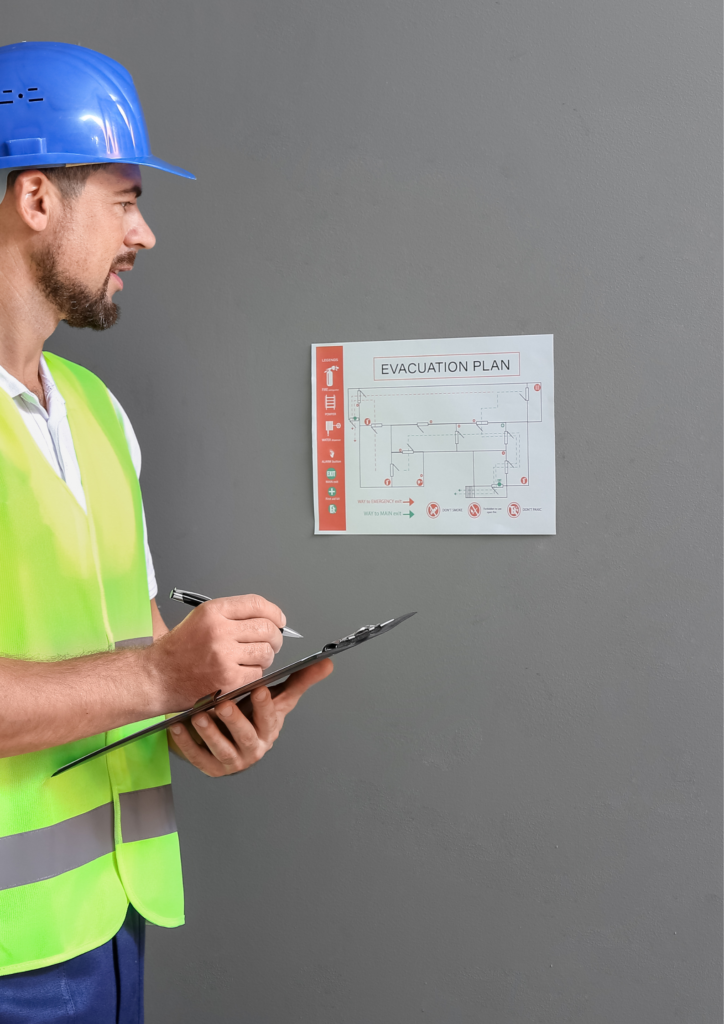
- a graphic part (location of fire-fighting equipment, fire-fighting devices, evacuation signs, evacuation plan, layout plan of the facility or facilities)
- appendices such as employee statements confirming that they have read the manual, safety data sheets for hazardous substances, and other requirements.
WHAT SHOULD FIRE SAFETY INSTRUCTIONS INCLUDE?
The content of the Fire Safety Manual is regulated by the Regulation of the Minister of Internal Affairs and Administration of 7 June 2010 on fire protection of buildings, other structures and areas.
- 6
- Owners, managers or users of facilities or parts thereof constituting separate fire zones, intended for public utility, collective housing, production, storage and livestock functions, shall provide and implement fire safety instructions containing:
(…)
3) procedures in the event of fire or other hazards;
4) methods of securing work that is hazardous in terms of fire, if such work is anticipated;
5) conditions and organisation of evacuation of people and practical methods of checking them;
6) methods of familiarising users of the facility, including employees,
with fire safety regulations and the content of these instructions;
7) fire safety tasks and responsibilities for regular users of the facility;
(…)
9) identification of persons or entities responsible for developing the instructions.
WHO CAN PREPARE FIRE SAFETY INSTRUCTIONS?
Fire safety instructions may be drawn up by persons who:
- hold the title of fire safety engineer or the professional title of firefighting engineer
- hold the title of fire protection specialist and have a higher education degree
- have obtained recognition of their qualifications to practise as a fire engineer
- hold the professional title of fire technician
- hold the title of fire protection inspector and have at least secondary education
- have obtained recognition of their qualifications to practise as a fire technician.
Contact EHS Consulting to learn more – we provide comprehensive health and safety services.
Industry information
Blog
No posts
Are you interested in our services?
+48 887 043 666