Polish Fire Protection Act 2026: Key Changes and Requirements
Fire protection is one of the pillars of safety in every building — residential, public, and industrial alike. The regulations governing this area are constantly updated in response to new hazards, evolving construction technologies and EU guidelines. In Poland, 2026 brings a further set of significant changes that property owners, facility managers and employers must take into account in their day-to-day operations.
Introduction to the Polish Fire Protection Act
The primary piece of legislation governing this area in Poland is the Act of 24 August 1991 on Fire Protection (consolidated text: Journal of Laws 2022, item 2057, as amended). It sets out the principles of organising fire protection in Poland, the obligations of building owners and managers, the powers of the State Fire Service (Państwowa Straż Pożarna, PSP), and the principles of funding fire protection.
The Act is supplemented by a number of implementing regulations, the most important of which are:
- Regulation of the Minister of Internal Affairs and Administration of 7 June 2010 on the fire protection of buildings, other structures and land — sets out detailed requirements for equipping buildings, maintaining documentation and organising evacuation;
- Regulation on detailed rules for fire protection of forests — governs fire protection of forested areas;
- Regulation on fire water supply and fire access roads — specifies technical requirements for water access and fire roads.
The entire Polish system is consistent with EU directives on building safety and the requirements of EN standards covering fire alarm systems, extinguishers and fixed firefighting systems.
Key Changes Introduced by the New Regulations
The amendments applicable from 2025 and entering into force in 2026 in Poland focus on several priority areas:
1. Digitalisation of Fire Safety Documentation
One of the biggest changes in Poland is the obligation to maintain and store the Fire Safety Instructions (IBP) in electronic form and to register them in the PSP’s ICT system. Previously, a paper form was sufficient. From 2026, owners and managers of buildings in categories ZL I, ZL II, PM (with a fire zone area exceeding 1,000 m²) and IN are required to submit the IBP to the relevant district PSP commander via the dedicated e-PSP portal.
2. Expanded Requirements for High-Rack Storage Buildings
In response to a series of warehouse and logistics hall fires, Polish regulations have tightened the requirements for PM buildings with high-rack storage (above 7 m). Mandatory fixed sprinkler systems (SUG) are now required for warehouse buildings with a fire zone area exceeding 2,000 m², down from the previous threshold of 5,000 m². At the same time, the timeframe for bringing existing buildings into compliance with the new requirements has been shortened.
3. New Regulations for Photovoltaic Installations
The rapid growth of renewable energy sources has led to photovoltaic (PV) installations being brought under detailed Polish fire protection regulations. From 2026, PV installations with a capacity exceeding 6.5 kWp mounted on public utility and production buildings require the installation of main DC circuit fire switches and marking of DC cable routes. The regulations also set minimum distances between PV modules and ventilation equipment and smoke extraction systems.
4. Updated Requirements for Fire Access Roads
The amended Polish regulations clarify requirements for maintaining the passability of fire access roads — building owners are required to mark them in accordance with the new standard PN-EN 17210 and ensure access at all times of year and day, without prior notification to the facility manager.
Obligations of Building Owners and Managers in Poland
Article 4 of the Polish Fire Protection Act imposes a broad range of obligations on building owners, managers and users. In light of the 2026 changes, these include:
- Drawing up or updating the Fire Safety Instructions (IBP) — required for buildings meeting the thresholds for volume, floor area or number of occupants; must be updated at least every 2 years or after every significant change to the building.
- Ensuring the operational readiness of fire protection systems and equipment — extinguishers, hydrants, fire alarm systems (SSP), voice evacuation systems (DSO), fixed firefighting systems (SUG), smoke dampers and smoke extraction equipment.
- Appointing a person responsible for fire protection — the owner or manager may perform this role personally or delegate it to an employee with the relevant qualifications.
- Conducting practice evacuations — at least once a year (for ZL II buildings — twice a year), with documentation of the process and findings.
- Marking evacuation routes — in accordance with PN-EN ISO 7010, using photoluminescent or illuminated signs ensuring visibility during power failure.
- Maintaining the passability of fire access roads and access to external hydrants — no parking, storage of materials or obstruction of access is permitted.
For PM (production and storage) buildings, there is also an obligation to maintain a register of fire-hazardous materials and to submit annual data on their quantities to the relevant PSP commander.
New Rules on Training and Certification in Poland
The regulatory changes significantly modify the requirements for training and certification of persons involved in fire protection in Poland.
Employee Training
Every employer in Poland is obliged to train employees in fire protection as part of initial OHS training (general induction) and periodic workstation-level training. The new Polish regulations specify that the training must cover:
- procedures in the event of a fire and how to alert the PSP,
- practical exercises in using portable firefighting equipment (extinguishers, fire blankets),
- knowledge of evacuation routes and assembly points,
- procedures for handling fire-hazardous materials (where applicable).
Certification of Installers and Service Technicians
From 2026 in Poland, the installation, commissioning and servicing of SSP, DSO, SUG and hydrant systems require a certificate issued by an accredited certification body. Existing construction licences are no longer sufficient for independently signing off fire protection systems — additional qualifications must be obtained or a certified specialist must be engaged. The register of certified installers is maintained by the Scientific and Research Centre for Fire Protection (CNBOP-PIB).
Qualifications of Fire Protection Inspectors
Persons acting as fire protection inspectors in large buildings (ZL I, ZL II and PM with a fire zone area exceeding 5,000 m²) must hold a fire protection inspector course accredited by the Chief Commander of the PSP, or a university degree in fire safety engineering.
Fire Protection Equipment Requirements in Poland
The Polish Regulation on fire protection of buildings sets out in detail the types and parameters of required equipment. The following rules apply in 2026:
Fire Extinguishers
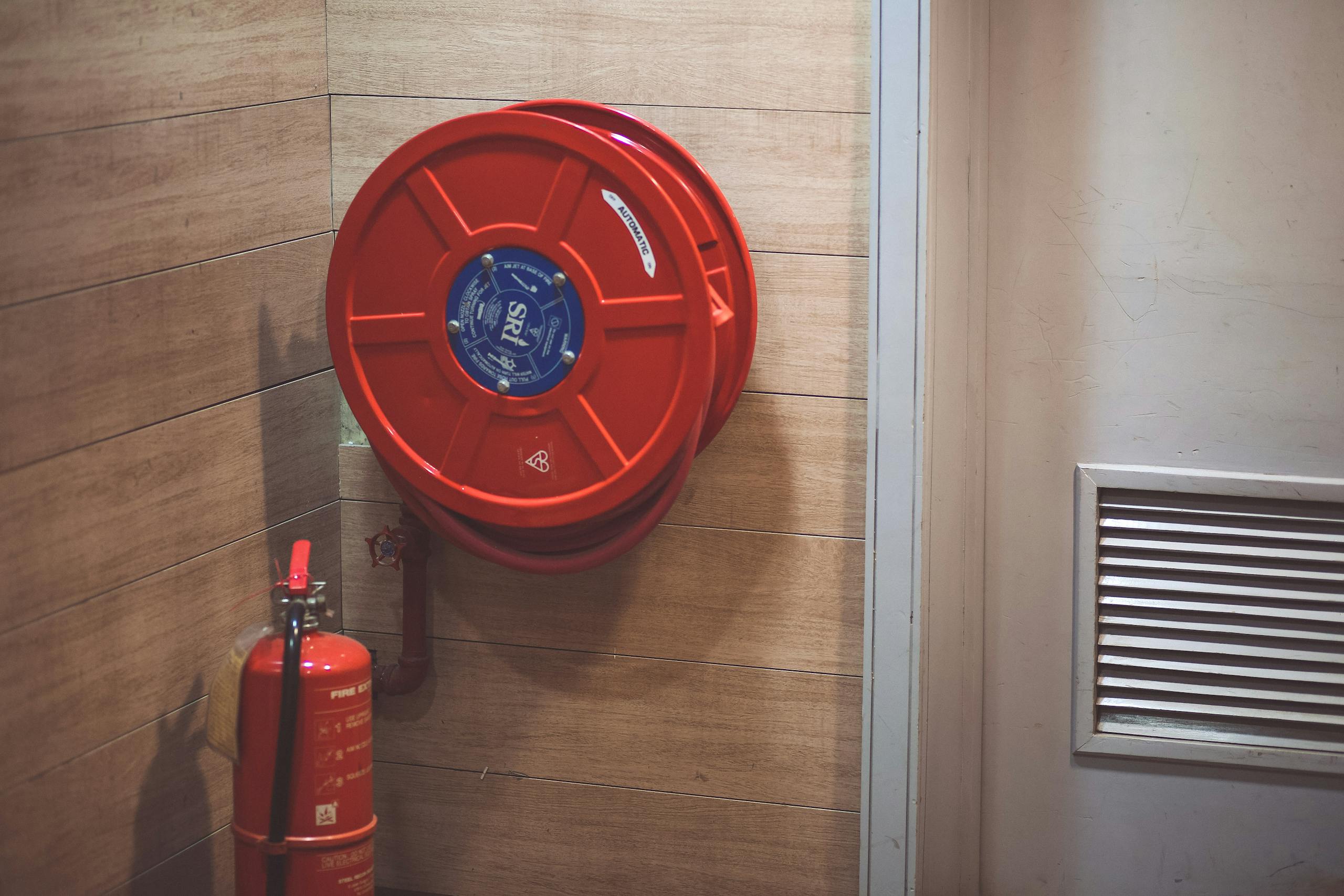
Extinguishers must bear CE marking and have up-to-date technical inspections (every 12 months or as specified by the manufacturer). The required extinguishing agent mass per extinguisher and placement rules remain unchanged (1 firefighting unit per 100 m² of floor area), but the new Polish regulations specify that in rooms with PV installations, only CO₂ or dry powder extinguishers suitable for live electrical installations are permitted.
Internal Hydrants and Fire Water Systems
In buildings required to have internal hydrants (ZL I, ZL II above 2 storeys; PM with fire zone area exceeding 1,000 m²), an annual inspection of the hydrant installation by an authorised company is mandatory, along with a pressure test every 5 years. Results must be documented and kept on the premises.
Fire Alarm Systems (SSP) and Smoke Extraction
SSP is now required in an ever-wider range of buildings under Polish law. The amendment has extended the requirement to collective residential buildings (hotels, guesthouses, student dormitories) with more than 50 overnight accommodation places, and to high-rise office buildings. Smoke extraction systems for stairwells and evacuation corridors must comply with PN-EN 12101 and be inspected every 6 months.
The Role of the State Fire Service in Enforcing Polish Regulations
The Polish State Fire Service (PSP) plays a key role in both prevention and oversight of compliance with fire protection regulations. PSP powers include:
- Preventive inspections — conducted ex officio or on request; district/municipal PSP commanders have the right to enter buildings to verify compliance; the building owner is obliged to make fire protection documentation available upon request.
- Inspection and reconnaissance activities — include assessment of the technical condition of fire protection systems, review of documentation, and test activation of fire protection systems.
- Administrative orders — where irregularities are found, the PSP commander may issue an order requiring their rectification within a set deadline, or — in the case of immediate danger — an order to close the building.
- Review of building design documentation — PSP issues opinions on building projects as regards fire protection requirements; a positive opinion is a prerequisite for obtaining an occupancy permit.
- Coordination of rescue and firefighting operations — in the event of a fire, the incident commander has the right to issue instructions to building owners and users, including ordering evacuation or making resources available.
Since 2025, the PSP has had an electronic inspection record system, enabling building owners to view their inspection history and the status of order implementation via the e-PSP portal.
Penalties for Breaching Polish Fire Protection Regulations
Polish fire protection law provides for three types of liability for violations:
Administrative Liability
The PSP commander may impose a financial penalty of between PLN 1,000 and PLN 50,000 by way of an administrative decision for failure to comply with an order within the prescribed deadline or for repeated breaches of the same provisions. In determining the amount of the penalty, the scale of the breach, the risk to people and property, and the offender’s prior conduct are taken into account.
Petty Offence Liability
Article 82 of the Polish Code of Petty Offences provides for arrest, reprimand or a fine of up to PLN 5,000 for careless handling of fire or flammable materials. Petty offences are heard by district courts or — in an expedited procedure — a fine is imposed by an authorised authority (the Police or PSP).
Criminal Liability
The most serious consequences apply to causing a fire or disaster threatening property or human life. Article 163 of the Polish Criminal Code provides for a custodial sentence of between 1 and 10 years, and in the event of loss of life — between 2 and 12 years. An employer who through gross negligence allowed a fire-related accident to occur may also face liability under Article 220 of the Criminal Code (exposing an employee to an immediate risk of loss of life or serious bodily harm).
Civil Liability
Independently of administrative and criminal sanctions, the owner or manager in Poland is civilly liable for damage caused by a fire resulting from failure to comply with fire protection requirements. Compensation may cover property losses, medical treatment costs, a disability pension for permanent health impairment, and — in the most severe cases — damages for the families of fatalities.
Summary — How to Prepare for the 2026 Changes in Poland
The fire protection regulatory changes applicable in Poland in 2026 affect every owner and manager of a building. The key steps to take as soon as possible are:
- Verify and update your Fire Safety Instructions (IBP) — ensure they are current and adapted to the new digital registration requirements.
- Check the technical condition of all fire protection systems and equipment — extinguishers, hydrants, SSP, DSO, SUG, smoke dampers. Carry out inspections before the PSP inspection deadline.
- Plan a practice evacuation — for ZL II buildings, at least twice a year; for others — once.
- Verify the qualifications of the person responsible for fire protection — ensure they meet the new certification requirements.
- Update your documentation for PV installations — if you have solar panels, check compliance with the new requirements.
If you are unsure where to start, or want to ensure your building meets all requirements under Polish law — contact EHS Consulting. We conduct fire safety audits, help draw up and implement Fire Safety Instructions, organise training and practice evacuations, and provide support in dealings with the State Fire Service.