How Much Can You Lift at Work in Poland? Manual Handling Weight Limits
Manual handling – lifting, carrying, pushing and pulling loads by hand – is part of everyday work in warehouses, production halls, shops and on outdoor sites, often with the help of simple equipment such as hand trucks. Polish OSH regulations set precise weight limits for this work, and they differ for women and men, for permanent and occasional work, and for pregnant and breastfeeding employees. Below we explain the limits and what the employer must do to organise manual handling safely.
Prefer to listen? Podcast episode (in Polish)
Lifting and carrying loads – what the terms mean
Even though much transport work has been mechanised, employees still lift and carry loads by hand on a daily basis. Polish regulations distinguish between two activities:
- Lifting a load – moving it vertically from a lower level to a higher one. In practice, lifting usually also involves moving the load some distance horizontally.
- Carrying a load (in the narrow sense) – lifting it and moving it at the same time over a distance of up to 2 m. Moving a load more than 2 m counts as lifting and carrying.
Rules for carrying loads correctly
- Hold the load as close to the body as possible – the strain increases with the distance between the load and the worker.
- Lift within the range from hand height to shoulder height. If the load is below hand height, use suitable loops, a harness or a hook.
- Keep the load in your hands for as short a time as possible.
- Avoid lifting at a high frequency (a fast pace).
- Minimise trunk movements while lifting (bending, leaning and twisting).
- Avoid large objects that are beyond arm’s reach or block your view.
- Avoid lifting objects with a shifting centre of gravity.
- Carry the load with your arms lowered. Carrying with the elbows bent doubles the strain on the muscles involved.
How much can an employee lift? Manual handling limits in Poland
Polish OSH regulations set weight limits for manual handling depending on:
- who is lifting (women or men),
- how many people are lifting (one person or a team),
- how the load is moved (on level ground, uphill, above shoulder height),
- whether the load is moved by hand only or with equipment such as trolleys,
- whether the work is permanent or occasional.
The table below summarises the limits for one worker. The details for each group are described further on.
| Situation (one worker) | Women | Men |
|---|---|---|
| Lifting and carrying | 12 kg permanent / 20 kg occasional | 30 kg permanent / 50 kg occasional |
| Lifting above shoulder height | 8 kg permanent / 14 kg occasional | 21 kg permanent / 35 kg occasional |
| Carrying over more than 25 m | 12 kg | 30 kg |
| Carrying uphill (slope up to 30°, height over 4 m) | 12 kg | 30 kg |
| Carrying uphill (slope over 30°, height over 4 m) | 8 kg permanent / 12 kg occasional | 20 kg permanent / 30 kg occasional |
| Force to start moving an object with both hands | pushing 120 N / pulling 100 N | pushing 300 N / pulling 250 N |
| Pregnant women | 3 kg | – |
| Breastfeeding women | 6 kg permanent / 10 kg occasional | – |
How much can a woman lift at work?
The weight of objects lifted and carried by one worker may not exceed 12 kg for permanent work and 20 kg for occasional work.
The weight of objects lifted by one worker above shoulder height may not exceed 8 kg for permanent work and 14 kg for occasional work.
If objects are carried by one worker over a distance of more than 25 metres, their weight may not exceed 12 kg.
If objects are carried by one worker uphill over uneven ground, ramps or stairs with a maximum slope of 30° and a height of more than 4 metres, their weight may not exceed 12 kg, regardless of the distance.
If objects are carried by one worker uphill over uneven ground, ramps or stairs with a slope of more than 30° and a height of more than 4 metres, their weight may not exceed 8 kg for permanent work and 12 kg for occasional work, regardless of the distance.
When moving objects with both hands, the force the worker needs to start the object moving, measured parallel to the ground, may not exceed 120 N when pushing and 100 N when pulling.
How much can a man lift at work?
The weight of objects lifted and carried by one worker may not exceed 30 kg for permanent work and 50 kg for occasional work.
The weight of objects lifted by one worker above shoulder height may not exceed 21 kg for permanent work and 35 kg for occasional work.
If objects are carried by one worker over a distance of more than 25 metres, their weight may not exceed 30 kg.
If objects are carried by one worker uphill over uneven ground, ramps or stairs with a maximum slope of 30° and a height of more than 4 metres, their weight may not exceed 30 kg, regardless of the distance.
If objects are carried by one worker uphill over uneven ground, ramps or stairs with a slope of more than 30° and a height of more than 4 metres, their weight may not exceed 20 kg for permanent work and 30 kg for occasional work, regardless of the distance.
When moving objects with both hands, the force the worker needs to start the object moving, measured parallel to the ground, may not exceed 300 N when pushing and 250 N when pulling.
Lifting and carrying by pregnant and breastfeeding women
Under Article 176 § 1 of the Polish Labour Code, pregnant and breastfeeding women may not perform work that is arduous, dangerous or harmful to health and could adversely affect their health, the course of the pregnancy or breastfeeding. The list of such work is set out in the Council of Ministers Regulation of 3 April 2017 on the list of work that is arduous, dangerous or harmful to the health of pregnant and breastfeeding women.
The list includes work involving excessive physical effort, including manual handling. Pregnant women should not manually lift and carry objects weighing more than 3 kg. For breastfeeding women the limit is 6 kg for permanent work and 10 kg for occasional work (performed up to 4 times per hour, provided that the total time of such work does not exceed 4 hours a day).
Transport routes for manual handling
Surface. The surface of transport routes should be hardened, smooth and wear-resistant, provide good grip, not generate dust when vehicles move on it, be non-absorbent and easy to wash, and be quick and easy to repair.
Marking. In industrial buildings, transport routes should be clearly and permanently marked (for example with lines painted in yellow).
Width. The recommended width of pedestrian transport routes in industrial buildings is calculated using the following formulas:
b = a + 30 cm for one-way traffic
b = 2a + 60 cm for two-way traffic
where:
a – the width of the load carried by the pedestrian, in cm;
b – the width of the transport route, in cm.
The minimum width of a transport route is 120 cm.
Types of mechanical internal transport
- Storage and warehouse transport,
- Production transport, which can be further divided into:
- transport between departments,
- transport within a department,
- transport at a workstation,
- transport between workstations.
It is carried out by means of transport with:
- intermittent movement (e.g. hoists, cranes, industrial trucks, rail trolleys),
- continuous movement (e.g. conveyors, pumps with pipelines).
Means of transport can also be divided by the direction in which the load is moved:
- vertical transport,
- horizontal transport,
- mixed transport.
Because means of transport used on site pose a serious risk to workers, the applicable OSH regulations and rules in this area must be strictly followed. The basic safety rules for operating transport equipment are:
- the equipment is in good technical condition, confirmed by an entry in its operating documentation,
- the surface on which the transport equipment moves is in good condition,
- the operators are properly trained and hold the required qualifications, where applicable,
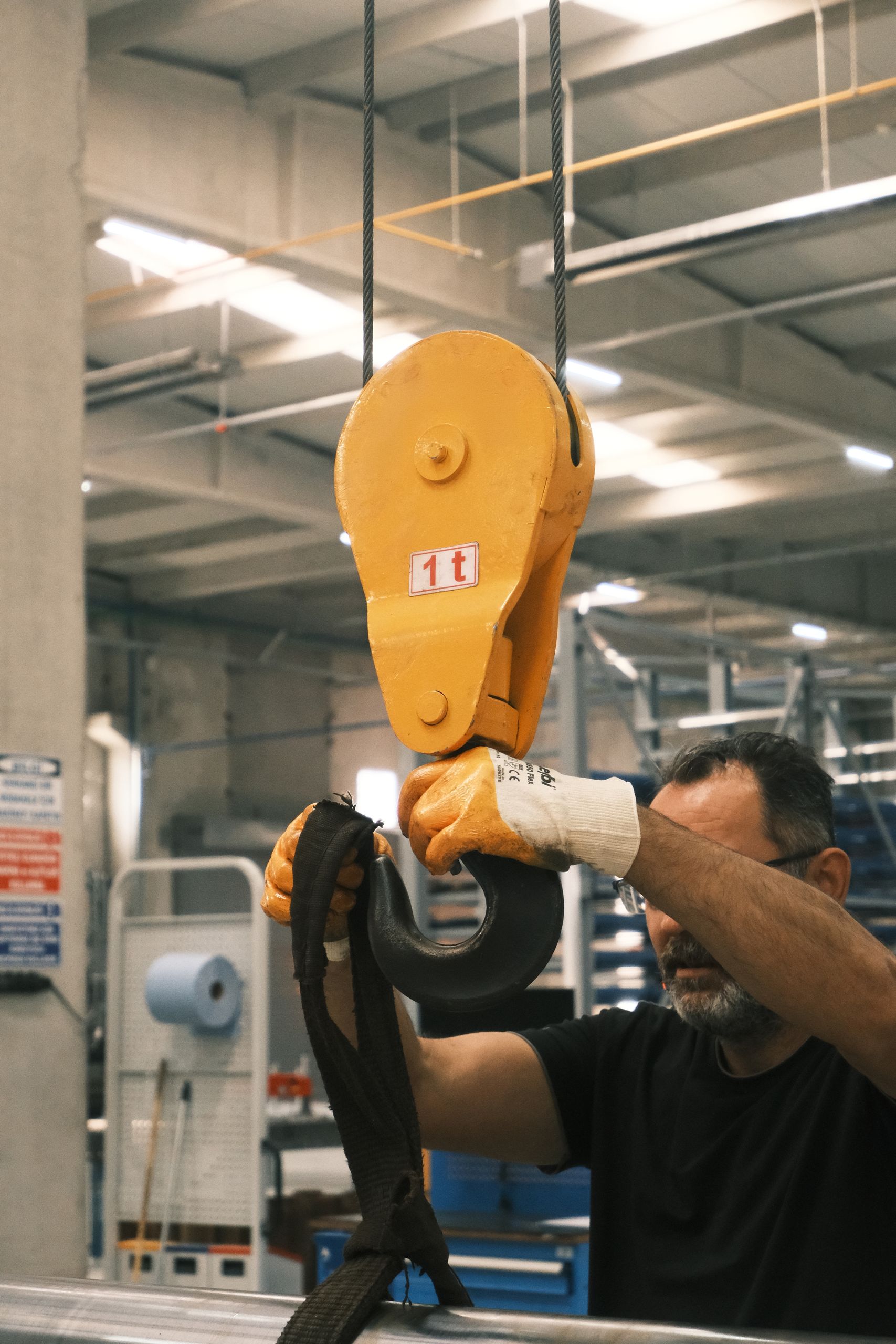
- only certified materials are used for parts of vertical transport equipment, such as chains, ropes, hooks, drums and pulleys,
- the area served by the transport equipment is properly lit,
- signalling devices work properly.
Moving harmful and hazardous materials
The organisation and methods of manually moving materials that may pose a hazard because of their properties (corrosive, toxic, dusty) should eliminate or reduce these hazards.
Sections 19 and 20 of the Regulation of the Minister of Labour and Social Policy of 14 March 2000 on occupational health and safety in manual handling and other work involving physical effort state:
“One worker may not carry hot or corrosive liquids, or liquids harmful to health, whose weight including the container and handle exceeds 25 kg for men and 10 kg for women.
Glass carboys containing acids or other corrosive liquids should be transported on special trolleys.”
Eliminating hazards in manual handling
Hazards can be eliminated or reduced when the employer and the people managing employees ensure safe and healthy working conditions. This means providing personal protective equipment (head, arm, leg and foot protection, clothing for outdoor work in changing weather conditions, hearing protection for work with mechanical equipment), work clothing and footwear, carrying out and documenting an occupational risk assessment, preparing OSH instructions for manual handling and making them available to employees, familiarising employees with the risk assessment and the safety instructions, and securing particularly hazardous work. It is also necessary to check that employees comply with OSH regulations and rules.
If you are not sure whether the loads handled at your workstations stay within the limits, an ergonomic audit will show where manual handling needs to be reorganised or supported with equipment.