Warehouse Fire with Disinfectants in Nowa Huta: What Can Employers Learn from It?
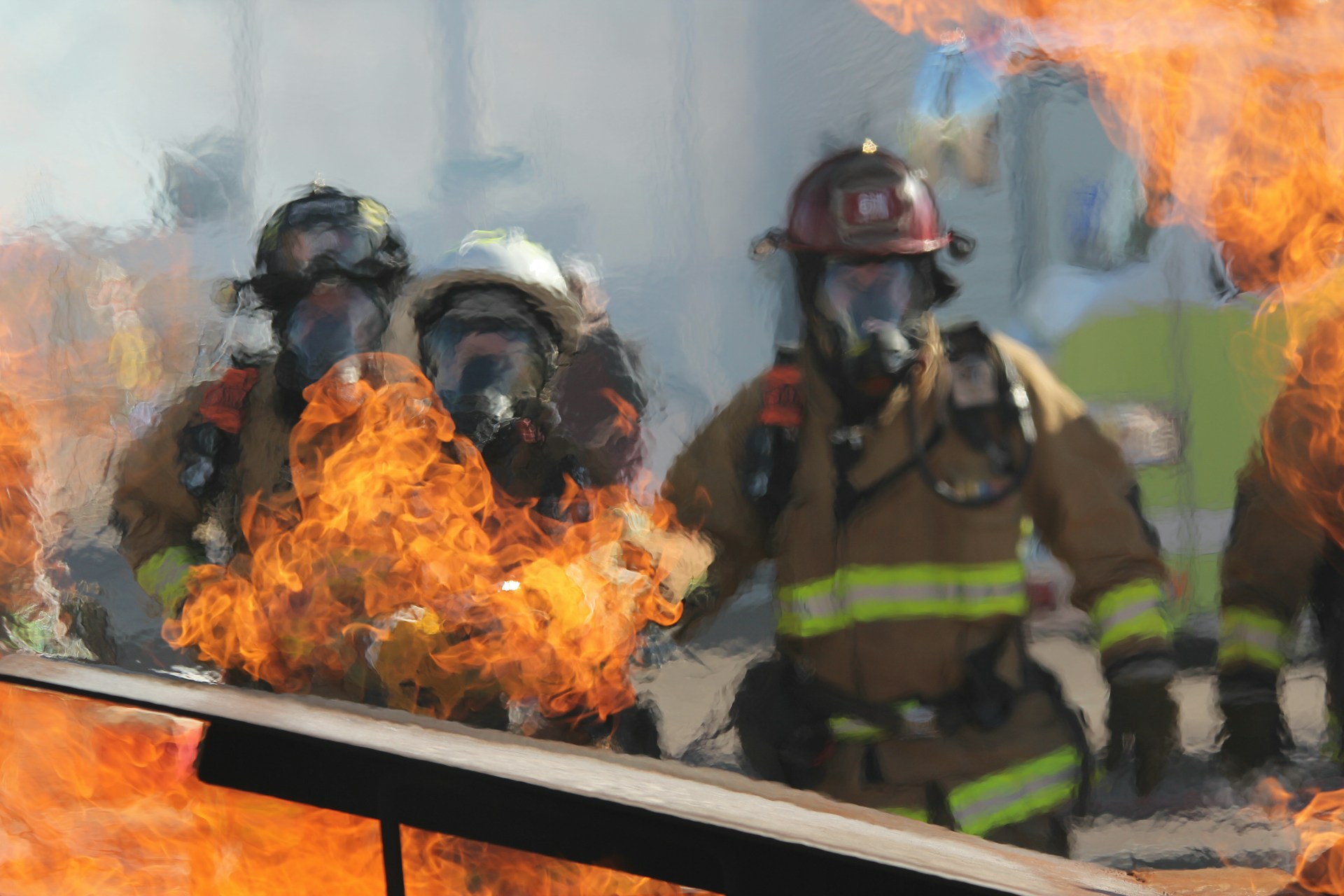
On Sunday, 27 September 2026, at around 1:20 p.m., a warehouse caught fire in the Nowa Huta district of Kraków, near Plac Błonie. It held a large quantity of flammable disinfectants. Nine crews of the State Fire Service (PSP), more than 40 firefighters in total, fought the blaze. No one was injured. Below we look at the incident from a fire safety perspective and suggest what is worth checking in your own company.
What do we know about the incident?
According to information released by the emergency services and the media:
- the fire engulfed a warehouse of approx. 12 × 40 m, located next to an office building,
- flammable disinfectants were stored in the warehouse,
- when the fire broke out, there were 10 people on site: 9 in the office section and 1 in the warehouse. All of them left the building before the fire brigade arrived,
- firefighters worked on two fronts: extinguishing the warehouse fire while protecting the neighbouring office building from the flames,
- the services urged people to stay away from the scene.
The cause of the fire has not yet been announced. It will be determined by experts and the fire service, so we will not speculate about what started it. It is, however, worth looking at the circumstances that matter to every facility storing similar materials.
Why are disinfectant liquids so dangerous?
Many hand and surface disinfectants are based on high concentrations of alcohols such as ethanol or isopropanol. Such products are often highly flammable liquids with a low flash point, sometimes below room temperature. This means that:
- their vapours can be ignited by a small ignition source, e.g. a spark, a hot surface or an electrostatic discharge,
- the vapours can form an explosive atmosphere with air, especially in poorly ventilated rooms,
- burning liquids spread quickly, while plastic containers melt and add fuel to the fire,
- the fire develops rapidly, and the high temperature endangers neighbouring buildings.
Since the pandemic, disinfectants have become an everyday item. That makes it easy to forget that in large quantities they are a fire-hazardous material, comparable to other solvents.
What went well?
The most important news from Nowa Huta is positive: no one was hurt, and everyone left the building before the emergency services arrived. This shows how important it is to have:
- an efficient way of raising the alarm,
- employees who know the evacuation routes,
- unobstructed emergency exits,
- prompt notification of the fire brigade.
A successful evacuation does not happen by itself. It is the result of preparation, training and drills – which employees often do not take seriously until a real alarm goes off.
Lesson 1: a flammable materials warehouse next to an office
In this incident, the warehouse was adjacent to an office building, and firefighters had to protect it from the fire. Combining office space and a flammable materials warehouse in one building, or in direct proximity, requires particular attention. The key points are:
- proper division into fire zones and an adequate fire resistance class of the separating walls,
- maintaining the required distances or using fire separations,
- well-planned arrangement of stored materials, away from the walls adjoining the office section.
Lesson 2: quantity and method of storage
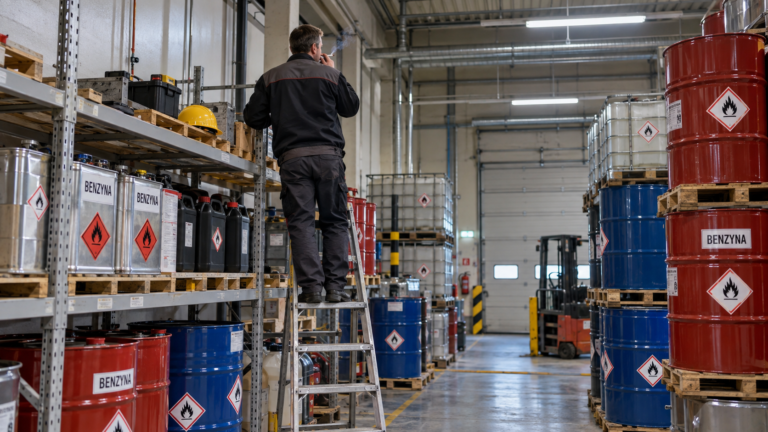
In many companies, stocks grow gradually. A warehouse designed for cardboard packaging starts to be used for pallets of highly flammable liquids, and no one checks whether this has changed the fire protection conditions of the building. It is worth regularly checking:
- what quantities of flammable materials are actually stored and whether they match the assumptions made for the building,
- whether dedicated areas for storing highly flammable liquids have been designated, ideally with spill containment trays,
- whether safe distances are kept from heat sources, electrical installations and light fittings,
- whether the safety data sheets (SDS) of the products are available and employees know what they say about storage (section 7) and physical and chemical properties, including the flash point (section 9).
Lesson 3: explosion risk assessment
Wherever highly flammable liquids are stored or decanted, an explosion risk assessment (OZW) must be carried out and, where necessary, explosion hazard zones must be designated. This entails requirements for electrical installations and equipment (e.g. explosion-proof design), ventilation and the dissipation of electrostatic charges. This is required by the Polish regulation on the fire protection of buildings and by the regulations on explosive atmospheres (ATEX), including the obligation to prepare an Explosion Protection Document (DZPW).
Lesson 4: documentation and people
Even the best technical safeguards will not work without prepared people. Among other things, the employer should:
- have up-to-date Fire Safety Instructions (IBP), if the building requires them, and adapt them to changes in how the building is used,
- designate employees responsible for firefighting and evacuation (Article 209¹ of the Polish Labour Code),
- provide working, regularly inspected firefighting equipment suited to the type of hazard,
- conduct practical evacuation drills – in buildings covered by IBP, at least once every two years,
- include fire and explosion hazards in the occupational risk assessment for warehouse workers.
Checklist questions for your company
After an incident like this, it is worth asking yourself a few simple questions:
- Do we know exactly how much flammable material we have in stock today?
- Do our Fire Safety Instructions describe how the building is used now, or how it was used a few years ago?
- Do we know where explosion hazard zones may occur in the building?
- Does every employee, including new and temporary staff, know how to raise the alarm and which way to exit?
- When did we last carry out an evacuation drill?
If even one answer is “I don’t know”, it is a good time for a review. The key changes in Polish fire protection law in 2026 are another reason to take a fresh look at your documentation.
How can we help?
At EHS Consulting, we support employers in fire protection and in working safely with hazardous substances. We carry out fire safety audits, prepare and update Fire Safety Instructions, explosion risk assessments and Explosion Protection Documents, and organise training and practical evacuation drills.
Sources (in Polish):